Cell Signalling
Gland - Any structure that secretes a hormone.
Hormone - Any chemical secreted by one part of the body that has its effect/s somewhere else. Two basic Types:
1. Steroid (Fat-based - non-polar - can diffuse through cell membranes)
2. Peptide ("Protein" - polar - bond to a receptor protein on cell surface). Pheremones - chemicals excreted by one individual that cause a physiological change in another individual.
I. Gonads - Primary sexual structures
A. Ovaries - produce estrogens & progesterone - responsible for female structure, menstral cycle & pregnancy.
B. Testes - Testosterone. Responsible for male anatomy, sperm production. How is it regulated? By the hypothalmus (Part of the brain - made up of Neurons) Pituitary (true gland) Negative Feedback System (HPNFS)
1. Hypothalamus - raises levels of GnRH (Gonadotropin Releasing Hormone)
2. Pituitary - is signalled by higher levels of GnRH to release LH (a gonadotropin)
3. Testes - are signalled by higher levels of LH to produce higher levels of Testosterone.
Monday, May 6, 2013

Friday, May 3, 2013
Colonies- permanent association of cells, but little or no integration of cell activities.
Volvox- unicellular green alga, colony is a hollow ball of cells.
Kingdom Protista-
Protists are the most diverse eukaryotic kingdoms.
-There are 15 distinct Phyla of Protists.
-These are grouped into five general groups based on shared characteristics
1. Presence/absence of flagella/cilia
2. Presence and kinds of pigments
3. The type of mitosis
4. the types of cristae in mitochondrea
5. Ribosomes are the same
-There are five major, subdivided groups.
1. Ameaboids- Heterotrophs with no permanent locomotor apparatus
2. Heterotrophs with flagella
3. Heterotrophs with restricted mobility (slime-molds)
4. Photosynthetic protists (algae)
5. Nonmotile spore-formers
Volvox- unicellular green alga, colony is a hollow ball of cells.
Kingdom Protista-
Protists are the most diverse eukaryotic kingdoms.
-There are 15 distinct Phyla of Protists.
-These are grouped into five general groups based on shared characteristics
1. Presence/absence of flagella/cilia
2. Presence and kinds of pigments
3. The type of mitosis
4. the types of cristae in mitochondrea
5. Ribosomes are the same
-There are five major, subdivided groups.
1. Ameaboids- Heterotrophs with no permanent locomotor apparatus
2. Heterotrophs with flagella
3. Heterotrophs with restricted mobility (slime-molds)
4. Photosynthetic protists (algae)
5. Nonmotile spore-formers
Thursday, May 2, 2013
5/2/2013
5/2/2013
Based on carbon and energy sources, prokaryotes can be divided into 4 groups
Lytic cycle
Based on carbon and energy sources, prokaryotes can be divided into 4 groups
- Photoautrouphs
- Use energy of sunlight to build organic molecules
- Cyanobacteria
- Chemoautotrouphs
- Obtain energy by oxidizing inorganic substances
- Photoheterotrouphs
- Rare
- Chemoheterotrouphs
- use organic molecules as carbon and energy sources
- Latin for poison
- Non-celklur particle with
- DNA or RNA
- 1 or 2 Protien coats (capsids)
- May have Viral Envelope - Phosholipids
- Do Not respire or grow
- ONLY function in a living cell
- Not given Latin names like living organisms
- 4 Charicteristics - Only have 1 (Genetic material
- Made of cells
- has metabolism
- reproduces on its own
- Genitic material
Lytic cycle
- 1- Virus absorption/ attachment
- 2 - Injection/ entry
- 3- Replication of viral parts
- 4- Assembly of the Virions
- 5- Release by lysis
- cause disease, cell gets taken over and produces more viruses that bust the cell
- Lays dormant in your body, doesn't destroy host cell
Wednesday, May 1, 2013
Wednesday May 1, 2013
Forming Life's Building Blocks
- Concerns have been raised about the "primordial soup" hypothesis
- No oxygen=> no protective ozone layer
- therefore, the UV light would have been destroyed and the essential ammonia and methane gases
- Louis Lerman, in 1986, proposed the bubble model
- When the experiment is done one of the things formed is urisil which is found in RNA
- The first step may have been the formation of tiny bubble termed microspheres
- Prokaryotes are small, simpily organized, single cells that lack a nucleus
- Include bacteria and archaea
- have a cell wall
- composed of peptidoglycan
- network of polysaccharides linked by peptide cross-links
- bacteria are separated into two groups based on membranes
- Peptidoglycan are in either a thick layer with no outer membrane that will stain (gram-positive) or in a thin layer with an outer membrane that won't stain (gram-negative)
- Hans Christian Gram developed a stain to differentiate between the two
- When cells are stressed they pass their plasmid DNA following cell-to-cell contact
- Based on carbon and energy sources, prokaryotes can be divided into four categories
- 1. Photoautotrophs: Photosynthesizes, or plants.
- Cyanobacteria: when a lake suddenly has an algae bloom and turns pea soup green, it's not algae, its cyanobacteria
- 2. Chemoautotrophs: use inorganic fuels as their food.
- For example: nitrogen-fixing bacteria, nitrifiers oxidize ammonia or nitrite
- 3. Photoheterotrophs: Use light as energy and pre-formed organic molecules as carbon sources
- Purple nonsulfur bacteria
- Very Rare
- 4. Chemoheterotrophs: Use organic molecules and energy sources
- Decomposers and most other types of bacteria.
Tuesday, April 30, 2013
Kingdom- Animalia
Phylum- Chordata
*Subphylum- Vertebrata
Class- Mammalia
*Subclass- Placenta
4/30/13
Order- Primate
*Superfamily- Hominoideae
Family- Hominidae
Genus- Homo
Species- sapiens
*Subspecies-sapiens
II. 1st Modification
*Sub...and Super... (due to the original system being unable to fit all species being discovered)
III. 2nd Modification
Added "Domain" above kingdom. There are 3 domains of life.
A. Bacteria- Have no internal membranes-no organelles, no nucleus, Peptidoglycan in cell wall, I kind of RNA polymerase, no Introns, no Histones (protein beads that DNA wraps around) in DNA, circular chromosome, different Ribosomes.
B. Archea- No internal membranes, organelles, or nucleus. Circular DNA, no peptidoglycon, several RNA polymerases, Introns, Histones
C. Eukarya- Have internal membranes, nucleus, organelles, no peptidoglycon, rod-like DNA, several RNA polymerases, Introns, and Histones.
Archae and Bacteria are both prokaryotes, but Eukarya and Archea are more closely related to each other.
Phylum- Chordata
*Subphylum- Vertebrata
Class- Mammalia
*Subclass- Placenta
4/30/13
Order- Primate
*Superfamily- Hominoideae
Family- Hominidae
Genus- Homo
Species- sapiens
*Subspecies-sapiens
II. 1st Modification
*Sub...and Super... (due to the original system being unable to fit all species being discovered)
III. 2nd Modification
Added "Domain" above kingdom. There are 3 domains of life.
A. Bacteria- Have no internal membranes-no organelles, no nucleus, Peptidoglycan in cell wall, I kind of RNA polymerase, no Introns, no Histones (protein beads that DNA wraps around) in DNA, circular chromosome, different Ribosomes.
B. Archea- No internal membranes, organelles, or nucleus. Circular DNA, no peptidoglycon, several RNA polymerases, Introns, Histones
C. Eukarya- Have internal membranes, nucleus, organelles, no peptidoglycon, rod-like DNA, several RNA polymerases, Introns, and Histones.
Archae and Bacteria are both prokaryotes, but Eukarya and Archea are more closely related to each other.
Monday, April 29, 2013
April 29, 2013
Categorizing Life
I. The Linnaeus Classification System
Kingdom- eg. Animalia
Phylum- Chordata
Class-Mammalia
Order- Primates
Family- Hominidae
Genus- Homo
Species- Sapiens
I. The Linnaeus Classification System
Kingdom- eg. Animalia
Phylum- Chordata
Class-Mammalia
Order- Primates
Family- Hominidae
Genus- Homo
Species- Sapiens
Tuesday, April 16, 2013
04/16/13


(the Carbon Cycle, Image A; the Nitrogen Cycle, Image B)
Nitrogen Cycle Continued:
Legume (any plant with seeds in a pod; examples are: alfalfa, peas)
Legumes have nitrogen fixing bacteria in their roots.
SYMBIOTIC RELATIONSHIP.
Tuesday, April 9, 2013
4/9/13
Gross Productivity - Total amount of Glucose produced by the producers.
Net Productivity - G.P. - Amount of Glucose metabolized by the producers, food energy available to consumers.
Initial = 0.8 mg/L of oxygen
Dark = 0.3 mg/L
Light= 0.9 mg/L
 Initial-Dark = 0.5 = Respiration Rate = 0.5/24
Light-Initial = Net Productivity Rate = 0.1/24
Light-Dark = Gross Productivity Rate = 0.6/24
The Carbon Cycle
Net Productivity - G.P. - Amount of Glucose metabolized by the producers, food energy available to consumers.
Initial = 0.8 mg/L of oxygen
Dark = 0.3 mg/L
Light= 0.9 mg/L
 Initial-Dark = 0.5 = Respiration Rate = 0.5/24
Light-Initial = Net Productivity Rate = 0.1/24
Light-Dark = Gross Productivity Rate = 0.6/24
Ecosystems
I. Biogeochemical CyclesThe Carbon Cycle
Monday, April 8, 2013
4/8/13
II. Food=Energy
Sun--Photosynthesis (Gross Primary Productivity)-->Producers--Cell Metabolism (90%)-->Heat
Producers--(10%)--> 1 Consumers/Herbivores (Net Primary Productivity)--(90%)-->Heat
1 Consumers--(10%)-->2 Consumers (1% Gross)--(10%)-->3 Consumers (0.1% Gross)--(10%)-->4 Consumer (0.01% Gross)
2, 3, & 4 Consumers are all Carnivores
Decomposers on every level
10% Rule--Only 10% of the energy produced by photosynthesis is available to Consumers. 90% is metabolized and "lost" as heat.
Food Pyramid of Biomass

90% is in the Producers (bottom)
9% Herbivores (middle)
1% Carnivores (top)
(You can make a living as a cow masseuse in Japan. Just saying.)
Biological Magnification--when fat-soluble toxins like pesticides (DDT) & metals (Pb, Mercury)
2 Ospreys 10lbs<---Large Fish 100lbs<---Small Fish 1000lbs<---Insects 10,000lbs<---Algae 100,000lbs
25 mg/L DDT 2.5 mg/L 0.25 mg/L 0.025 mg/L 0.0025 mg/L DDT
Sun--Photosynthesis (Gross Primary Productivity)-->Producers--Cell Metabolism (90%)-->Heat
Producers--(10%)--> 1 Consumers/Herbivores (Net Primary Productivity)--(90%)-->Heat
1 Consumers--(10%)-->2 Consumers (1% Gross)--(10%)-->3 Consumers (0.1% Gross)--(10%)-->4 Consumer (0.01% Gross)
2, 3, & 4 Consumers are all Carnivores
Decomposers on every level
10% Rule--Only 10% of the energy produced by photosynthesis is available to Consumers. 90% is metabolized and "lost" as heat.
Food Pyramid of Biomass
90% is in the Producers (bottom)
9% Herbivores (middle)
1% Carnivores (top)
(You can make a living as a cow masseuse in Japan. Just saying.)
Biological Magnification--when fat-soluble toxins like pesticides (DDT) & metals (Pb, Mercury)
2 Ospreys 10lbs<---Large Fish 100lbs<---Small Fish 1000lbs<---Insects 10,000lbs<---Algae 100,000lbs
25 mg/L DDT 2.5 mg/L 0.25 mg/L 0.025 mg/L 0.0025 mg/L DDT
Thursday, March 28, 2013
3/28/13
I.
B. Predation
2.
d. Keystone Predator
ii. Maintain Species Diversity- preys on the most commonly occurring species leaving more resources for the less commonly occurring species.
C. Symbiosis- "living together". At least one species in the relationship has a lifelong dependance on the other. Three types:
1. Parasitism (+/-)- When one species (parasites) lives off of and on or in another (host).
2. Mutualism (+/+)- both species benefit.
a. Flowering Plants and Pollinators- 70% of plants flower.
 b. Lichen- an alga and a fungus. Fungus excretes digestive enzymes break down substrate to get nutrients (N, P, S, Na+, K+, etc) and alga photosynthesizes to make sugars and fats. First step in soil formation.
 c. Commensalism- (+/0)- one species benefits and the other is unaffected. Epiphytes- plants that live on other plants- Orchids


B. Predation
2.
d. Keystone Predator
ii. Maintain Species Diversity- preys on the most commonly occurring species leaving more resources for the less commonly occurring species.
C. Symbiosis- "living together". At least one species in the relationship has a lifelong dependance on the other. Three types:
1. Parasitism (+/-)- When one species (parasites) lives off of and on or in another (host).
2. Mutualism (+/+)- both species benefit.
a. Flowering Plants and Pollinators- 70% of plants flower.

Tuesday, March 26, 2013
Communities
I. interactions
A. Competition- resources. 2 types
1. Intraspecific- within the same species (population)
2. Interspecific- between 2 or more species. Leads to the Principle of Competitive Exclusion-when 2 or more species are competing fo the same resources, 1 will "win". The other/s will either become extripated or they will shift their niche. Niche- an organism's profession. Leads to Resource Partitioning- resources are divided up by competing species. Ex. elk, moose, deer/ broadleaf, conifers. Exotic Species (non-native)- on the mainland the natives usually win.
I. interactions
A. Competition- resources. 2 types
1. Intraspecific- within the same species (population)
2. Interspecific- between 2 or more species. Leads to the Principle of Competitive Exclusion-when 2 or more species are competing fo the same resources, 1 will "win". The other/s will either become extripated or they will shift their niche. Niche- an organism's profession. Leads to Resource Partitioning- resources are divided up by competing species. Ex. elk, moose, deer/ broadleaf, conifers. Exotic Species (non-native)- on the mainland the natives usually win.
Monday, March 25, 2013
Ecology part 3
III. Other Factors
B.
2. Survivor ship Curves

3. Cohort Sizes
-Cohort: particular age class
IV. Population Survival Strategies:
2 types:
A. r-selected: (weeds, insects, rodents, fish, grasses)
Age at first Reproduce- Early
Lifespan- short
Maturity- Early
Number of Offspring-Many
Early Mortality?- YES
Parental Care?- NO
Size- Small
Succession Type- Pioneer
B. k-selected: (humans, larger trees, large herbivores)
Age at first Reproduction- Late
Lifespan- Long
Maturity-Late
Number of Offspring- Few
Early Mortality?- NO
Parental Care?- YES
Size- Large
Succession Type- Climax
B.
2. Survivor ship Curves

3. Cohort Sizes
-Cohort: particular age class
IV. Population Survival Strategies:
2 types:
A. r-selected: (weeds, insects, rodents, fish, grasses)
Age at first Reproduce- Early
Lifespan- short
Maturity- Early
Number of Offspring-Many
Early Mortality?- YES
Parental Care?- NO
Size- Small
Succession Type- Pioneer
B. k-selected: (humans, larger trees, large herbivores)
Age at first Reproduction- Late
Lifespan- Long
Maturity-Late
Number of Offspring- Few
Early Mortality?- NO
Parental Care?- YES
Size- Large
Succession Type- Climax
Friday, March 22, 2013
Other Factors that Affect Growth
III. Other Factors that Affect Growth
A. Sex Distribution
1. In a polygamous population to max. growth: Females > Males
2. In a monogamous population to max. growth: Females = Males
B. Age Distribution
1. The younger a population is, the faster it grows.
A. Sex Distribution
1. In a polygamous population to max. growth: Females > Males
2. In a monogamous population to max. growth: Females = Males
B. Age Distribution
1. The younger a population is, the faster it grows.
Thursday, March 21, 2013
Ecology
1. Population- a group of individuals of the same species living within the same area. (Territory)
2. Community- all of the populations that interact within a given area.
3. Ecosystem- community plus all the abiotic- nonliving, factors that affect it.
4. Ecosphere- gloabl ecology
Population Ecology
I. Population Dynamics- How populations change.
A. Growth- what factors affect it?
1. Emmigration (-) Movement out
2. Immigration (+) Movement into
3. Natality (+) Birth Rate
4. Mortality (-) Death Rate
B. Growth Rates- 3 types
1. Arithmetic- same amount of increase within each growth period. Bad way to calculate growth.

2. Exponential- population grows by the same percent (%) each year. Use this when a population is small with lots of room to grow. (J-shaped curve)

equation: delta N/delta t = rN
delta N= change in # (unknown)
delta t= change in time
r= % rate (convert % to decimal)
N= current #
Example:
cattle herd; 2011= 50, 2012=60, 2013= ?
delta N/1= rN
delta N= (.2)(60) = 12 60+12= 72
3. Biological- population will eventually slow down and stop due to resource limitations.Eventually it will reach its carrying campacity- the maximum number a given enviorment can support on a long-term basis.
(S-shaped cuve)

Equation
delta N/ delta t= rN(K-n/K)
K= carring capacity
Example:
cattle herd; 2011= 50, 2012=60, 2013=?
=(.2)(60)(100-60/100)
=(12)(.4)
=4.8 round to 5
=2013=65
Wednesday, March 13, 2013
II Regulation of Muscle Contraction
A. The Motor Cortex of the brain (Kenzie) releases motor impulse (Erin) down pathway leading to target muscle
B. It reaches the Synaptic Knob (Bryan) where a Neurotransmitter (Ach-Brennan) is released into the Neuromuscular Junction - the synapse between nerve and muscle
C. Ach bonds to receptor sites on the Sarcoplasmic Reticulum (SR-Holden) Membrane which surrounds and permeates muscle and also holds a resting charge. The SR will now "fire" and release Ca2+ (Carson) ions into the muscle fibers.
D. Ca2+ will now bond to Troponin (Maddie). Troponin is a smaller protein found along the length of a larger, cable-like, protein called Tropomyosin.
E. This causes the Tropomyosin cable to shift position exposing the Actin Binding Sites (Rachel) to the Myosin Heads (Bryar). RESULT: CONTRACTION.
NOTE: The regulation of Muscle Contraction (strength and duration) is directly controlled by the amount of Ca2+ that are bonded to Troponin molecules at any one time.
A. The Motor Cortex of the brain (Kenzie) releases motor impulse (Erin) down pathway leading to target muscle
B. It reaches the Synaptic Knob (Bryan) where a Neurotransmitter (Ach-Brennan) is released into the Neuromuscular Junction - the synapse between nerve and muscle
C. Ach bonds to receptor sites on the Sarcoplasmic Reticulum (SR-Holden) Membrane which surrounds and permeates muscle and also holds a resting charge. The SR will now "fire" and release Ca2+ (Carson) ions into the muscle fibers.
D. Ca2+ will now bond to Troponin (Maddie). Troponin is a smaller protein found along the length of a larger, cable-like, protein called Tropomyosin.
E. This causes the Tropomyosin cable to shift position exposing the Actin Binding Sites (Rachel) to the Myosin Heads (Bryar). RESULT: CONTRACTION.
NOTE: The regulation of Muscle Contraction (strength and duration) is directly controlled by the amount of Ca2+ that are bonded to Troponin molecules at any one time.
Tuesday, March 12, 2013
Muscle Contraction (Skeletal)
- Skeletal Muscles are arranged in Antagonistic Groups.
- Every Muscle is connected on two sides by tendons.
- Muscles are composed of multicellular structures called muscle fibers (visible)
- Muscle Fibers are composed of long multinucleated cells that stretch across the entire muscle.
- Muscle cells are composed of subcellular tubules called Myofirils. Each myofibril is composed of two major protiens called myosin and actin.
- Each myofibril is divided in structures call sarcrameres which are the structural and functional uint of a muscle.
A. When a muscle is relaxed, there is a protien that covers the Actin Binding Sites and this will Not allow teh myosin bonds to bond, so the two fibers, Actin and Myosin will slide freely across one another.
B. However, when an electrical impulse is sent to the muscle, the actin binding sites are exposed, the myosin heads will bond to jthe creating crossbridges.
C. This changes the structure of the myosing head and it will ratchet the actin strand toward the A-Zone. closing the distance between the myosing head and the acting binding site.
D. Once this happends the Myosing head reverts back to it's original structure and position.
E. The head will now find a new actin binding site and the process will continue until:
1The muscle is fully contracted
2 The electrical impulse stops.
3ATP Runs out- cramp, Rigor rigor Mortis:I(Stiffness of Death)
Monday, March 11, 2013
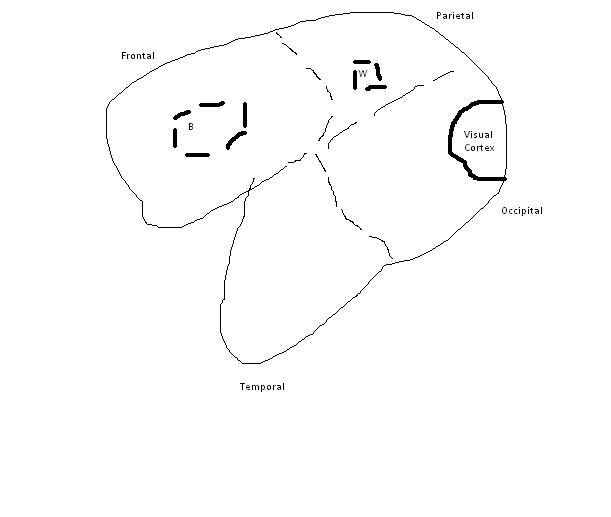
Split Brain- Happens when the Corpus collosum is severed. Usually because of a surgical proceure, used to stop seizures in epileptics. *(images seen from the right side are transmitted to the left and vice versa)
-The Visual cortex is in the occipital lobe, in the back of the head, this is where we "see" images.
-The Auditory cortex is in front of the Visual; this is where we "hear" -it is not counter (right ear to right brain, left ear to left brain)
-Motor cortex is between the Frontal and the Periatal lobe. (controls motor neurons) -Is Counter.
-Behind it, in the periatal lobe, is the Sensory cortex, where sensory neurons "report to"
-The Visual cortex is in the occipital lobe, in the back of the head, this is where we "see" images.
-The Auditory cortex is in front of the Visual; this is where we "hear" -it is not counter (right ear to right brain, left ear to left brain)
-Motor cortex is between the Frontal and the Periatal lobe. (controls motor neurons) -Is Counter.
-Behind it, in the periatal lobe, is the Sensory cortex, where sensory neurons "report to"
Friday, March 8, 2013
Lecture 3/8/2013
III.Forebrain
C. Hypothalamus-Thermostat, Chemostat (pH, blood sugar), site of Base Emotions (Anger, Euphoria, Hunger, Thirst, Sex)
D. Cerebrum - 80%, Convoluted to increase surface area because majority of electrical activity is on the surface. Divided into 2 hemispheres (Left and Right) connected by the Corpus Callosum.

The Right Hemisphere controls and receives to and from the Left side of the Body and vice versa.
Vision - The Right Visual Field goes to the left Hemisphere and vise versa.
B) Broca's Area - Produces motor speech. 90% of us it is in the left hemisphere.
W) Wernicke's Area - Produces motor speech meaning.
C. Hypothalamus-Thermostat, Chemostat (pH, blood sugar), site of Base Emotions (Anger, Euphoria, Hunger, Thirst, Sex)
D. Cerebrum - 80%, Convoluted to increase surface area because majority of electrical activity is on the surface. Divided into 2 hemispheres (Left and Right) connected by the Corpus Callosum.
The Right Hemisphere controls and receives to and from the Left side of the Body and vice versa.
Vision - The Right Visual Field goes to the left Hemisphere and vise versa.
B) Broca's Area - Produces motor speech. 90% of us it is in the left hemisphere.
W) Wernicke's Area - Produces motor speech meaning.
Thursday, March 7, 2013
The Brain
I. Hindbrain
A. Medulla Oblongata- connects directly to spinal cord. Reflexes (coughing, sneezing, reflex arcs, etc.) Last structure to "die" when oxygen runs out. Responsible for basic body function: heart rate and breathing.
B. Cerebellum- coordinates complex motor skills. Athletics, dance, etc.
II. Midbrain- (+ Hindbrain=Brainstem)
A. Superior and Inferior Colliculi- involved in coordination of visual and auditory stimuli
B. Reticular Fornation- "Internal clock." Regulates states of consciousness
III. Forebrain
A. Basal Ganglia, Amygdala, and Hippocampus- Long-term memory
B. Thalamus- Relay center for the brain.
C. Hypothalamus- Thermostat
A. Medulla Oblongata- connects directly to spinal cord. Reflexes (coughing, sneezing, reflex arcs, etc.) Last structure to "die" when oxygen runs out. Responsible for basic body function: heart rate and breathing.
B. Cerebellum- coordinates complex motor skills. Athletics, dance, etc.
II. Midbrain- (+ Hindbrain=Brainstem)
A. Superior and Inferior Colliculi- involved in coordination of visual and auditory stimuli
B. Reticular Fornation- "Internal clock." Regulates states of consciousness
III. Forebrain
A. Basal Ganglia, Amygdala, and Hippocampus- Long-term memory
B. Thalamus- Relay center for the brain.
C. Hypothalamus- Thermostat
Wednesday, March 6, 2013
March 6, 2013
IV. Synapse
A. Excitatory
1. When the nerve impulse reaches the synaptic knob, sodium comes rushing in, making the interior positive. (35+)
2. This knocks Ca2+ off of its binding sites on the inner membrane, and it bonds to the synaptic vessicles.
3. This releases excitatory neurotransmitters into the synaptic cleft where it bonds to the receptor sites on the post-synaptic membrane of the next neuron.
4. This opens the sodium gates, making the resting charge closer to the threshold (-50). It it reaches -50mv, it will "fire".
B. Inhibition - post-synaptic neuron is less likely to fire.
1. Same
2. Same
3. An inhibitory neurotransmitter is released into the cleft and it bonds to receptor sites on the post-synaptic neuron.
4. This opens chlorine channelse and chlorine diffuses in, making the interior more negative (-90) and less likely to fire.
Note 1: All neurotransmitters must be immediately broken down by enzymes or else their effect will continue long after the impulse stops.
Note 2: These neurotransmitters are constatly battling with one another in the synapses of our body. The Parasympathetic Nervous System is the reason why our neurons are less likely to fire at night.
Note 3: Summation - When the sum total of Excitatory (+) and Inhibitory (-) neurotransmitters "add up" to the Post-synaptic neuron reaching the threshold. 2 types:
1. Temporal - one or a few neurons are firing enough times within a given unit of time to achieve summation. (quickly putting your finger on a piece of ice)
2. Spacial - many neurons fire at once and release enough neurotransmitters to achieve summation (putting your whole hand quickly on the table)
A. Excitatory
1. When the nerve impulse reaches the synaptic knob, sodium comes rushing in, making the interior positive. (35+)
2. This knocks Ca2+ off of its binding sites on the inner membrane, and it bonds to the synaptic vessicles.
3. This releases excitatory neurotransmitters into the synaptic cleft where it bonds to the receptor sites on the post-synaptic membrane of the next neuron.
4. This opens the sodium gates, making the resting charge closer to the threshold (-50). It it reaches -50mv, it will "fire".
B. Inhibition - post-synaptic neuron is less likely to fire.
1. Same
2. Same
3. An inhibitory neurotransmitter is released into the cleft and it bonds to receptor sites on the post-synaptic neuron.
4. This opens chlorine channelse and chlorine diffuses in, making the interior more negative (-90) and less likely to fire.
Note 1: All neurotransmitters must be immediately broken down by enzymes or else their effect will continue long after the impulse stops.
Note 2: These neurotransmitters are constatly battling with one another in the synapses of our body. The Parasympathetic Nervous System is the reason why our neurons are less likely to fire at night.
Note 3: Summation - When the sum total of Excitatory (+) and Inhibitory (-) neurotransmitters "add up" to the Post-synaptic neuron reaching the threshold. 2 types:
1. Temporal - one or a few neurons are firing enough times within a given unit of time to achieve summation. (quickly putting your finger on a piece of ice)
2. Spacial - many neurons fire at once and release enough neurotransmitters to achieve summation (putting your whole hand quickly on the table)
Subscribe to:
Posts (Atom)